Is one day in Rome enough?
One day in Rome is not enough to know Rome — but it is enough to see its postcard. If you start before 9 a.m. with pre-booked entries, a realistic one-day itinerary covers four to six landmark sights, 8 to 11 hours on the ground, and 5 to 8 km of walking. Anything more is fantasy; anything less leaves you feeling underserved.
Rick Steves, the most-quoted English-language authority on time-limited European travel, opens his Rome itinerary with the line: "Some people actually 'do' Rome in a day. Crazy as that sounds, if all you have is a day, it's one of the most exciting days Europe has to offer." That framing is right. Yes, it's possible. No, you won't see Rome. But you will see the Eternal City's headline cast — the Colosseum, the Vatican Museums, the Sistine Chapel, the Pantheon, the Trevi Fountain, and the centro storico — and most travelers who do Rome in a day come back later for longer. Few regret the day they had.
The catch is logistics. The Colosseum admits up to 20,000 visitors a day under a 3,000-person concurrent cap. The Vatican Museums host 6 million visitors a year and the on-site queue can run 1 to 2 km along Viale Vaticano in July. Both sites require timed-entry tickets that release roughly 30 days in advance and regularly sell out for peak dates. The one-day Rome problem is not what to see — it's the 4 km gap between the Vatican and the Colosseum, the 2-hour Vatican queue, and the 30 minutes you'll spend deciding where to eat lunch.
The short answer. Book a guided combo tour. It removes the two queues, the transfer between sites, and the lunch decision in one transaction — and a small-group day tour costs about the same as the two skip-the-line tickets plus a taxi between them.
The itinerary at a glance
The format below is the structure used by Walks of Italy, The Tour Guy and The Roman Guy on their full-day combo tours — and the one most independent travelers report works best. Vatican in the morning before the 10:30–13:00 tour-bus surge; lunch transfer to the Colosseum; afternoon at the ancient sites while the light is still soft; evening through the floodlit historic centre.
| Time | Where | Why now |
|---|---|---|
| 08:00 | Vatican Museums opening | The 08:00 slot has 10–20 min security waits; tour buses haven't arrived |
| 10:30 | Sistine Chapel | Crowd density doubles after 11:00 — be already inside |
| 11:15 | St Peter's Basilica | Guided groups use the Sistine→Basilica connecting door, skipping the security queue |
| 13:00 | Lunch + transfer | 15-min taxi or 25-min Metro to the Colosseum; eat one street back from any monument |
| 14:30 | Colosseum | Afternoon Colosseum is manageable; Forum light is best 15:30–17:00 |
| 17:00 | Pantheon | The single most-underrated wow moment in Rome; €5 entry since 2023 |
| 18:00 | Centro storico walk | Piazza Navona → Trevi Fountain → Spanish Steps, all floodlit after dark |
| 20:30 | Trastevere dinner | The neighborhood across the river where Romans actually eat |
Total walking: roughly 8 km — significantly more than most first-time visitors anticipate. Pack closed-toe shoes; the basalt sampietrini cobblestones are notoriously hard on dress shoes.
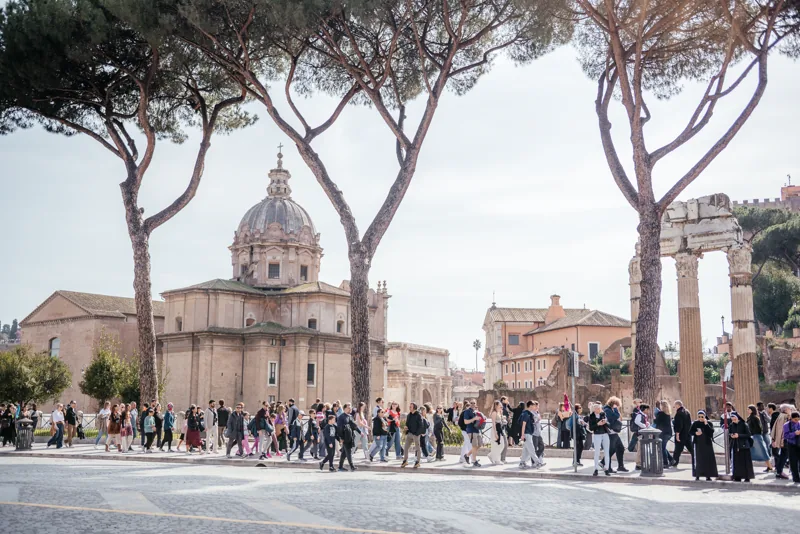
Ultimate Rome: Colosseum, Vatican Museums & Walking Tour
Timed skip-the-line entry to the Vatican Museums and the Colosseum, time inside the Sistine Chapel with expert commentary, and a guided walk through the centro storico past the Trevi Fountain and the Pantheon — all in one expertly planned small-group day.
The four anchor experiences
Rome has 900+ listed monuments, 300+ churches, 280+ fountains and four UNESCO sites inside the city limits. In a single day, four anchor experiences carry the wow load: the Colosseum, the Vatican, the Pantheon, and the centro storico walk. Everything else is filler around them.
The Colosseum, Forum & Palatine Hill
The 1st-century amphitheatre held 50,000 to 80,000 spectators. Beneath the (now-reconstructed) wooden floor, the hypogeum contained 36 trapdoors that lifted gladiators and animals into the arena. Two thousand years later, up to 20,000 visitors still pass through daily. A guided tour names the velarium awning rigged by the Imperial Navy, the emperor Commodus's actual gladiator fights, and the 19th-century reconstruction you're standing on — context the ruins themselves don't volunteer.
The Vatican Museums, Sistine Chapel & St Peter's Basilica
Nine miles of galleries — the second most-visited museum in the world. Michelangelo painted the Sistine ceiling between 1508 and 1512 and returned for The Last Judgment in 1534. Most independent visitors miss the Raphael Rooms entirely because the signage to the Sistine pulls them straight past. The Basilica connecting door from the Sistine — used to skip the separate 45-minute security queue outside — is open only to licensed guided groups (closed Wednesdays during Papal Audiences).
Sistine Chapel preservation note for 2026. The Vatican is running a conservation project on Michelangelo's Last Judgment from 12 January to 31 March 2026. Some scaffolding may be present on the altar wall during early-2026 visits. The ceiling is not affected.
The Pantheon
Built under Hadrian around 126 AD and continuously used ever since. The 8.8-metre oculus is the only light source; on 21 April — Rome's mythological founding date — the noon sun aligns through it directly onto the bronze entrance doors for roughly 2 minutes 50 seconds. On Pentecost, red rose petals are dropped through the oculus inside the church. The interior is acoustically and visually startling in a way photographs cannot communicate.
"The Pantheon was a must see for me, not terribly crowded and so special."— Rick Steves forum traveler
The centro storico walk (Trevi, Navona, Piazza del Popolo)
The Pantheon to Piazza Navona is a four-minute walk. Navona to the Trevi Fountain is eleven. Trevi to the Spanish Steps is eight. The entire centro storico walk runs roughly two hours, completely free, and is at its best after dark — Caravaggio-lit street lamps, cooler temperatures, crowds a fraction of what they are at noon. The Trevi Fountain receives roughly €3,000 in coins daily, collected at midnight and donated to the Catholic charity Caritas.
Why a guided tour for one day
This is the section where editorial honesty earns its keep. For two-plus days in Rome, self-guided is fine. For one day, the queue math, the wayfinding math, and the decision-fatigue math all point in the same direction.
The queue math
The Colosseum on-site ticket counter runs 60–90 minutes in peak season and regularly exceeds two hours; the Vatican equivalent runs 60–90 minutes and has been documented at three hours along Viale Vaticano. Both can be skipped with a pre-booked timed ticket or a guided-group entrance. That's a 2-to-4-hour saving across the day. With one chance at Rome, those hours are not interchangeable.
The honest "skip-the-line" definition
Skip-the-line means skipping the ticket-purchase queue. Everyone — pope, tour guide, VIP — still clears security. What skip-the-line does save: the 2-hour wait to buy a ticket on the day. What it doesn't save: the 10–30 minute security screen. A useful frame: "Skip-the-line is poorly named. It should be called skip-the-ticket-counter."
The decision-fatigue math
Rome has 300+ churches, 280+ fountains, 900+ listed monuments. Independent first-timers spend 30–45 minutes per major decision (which restaurant, which entry, which order) and that compounds across a day. A pre-built itinerary buys back those decision-minutes.
What a guide adds beyond logistics
- Storytelling. The Colosseum without a guide is a large ruin; with one, it is where Emperor Commodus fought as a gladiator, where the velarium awning was rigged by the Imperial Navy, and where the floor you're standing on is a 19th-century reconstruction above the hypogeum.
- Vatican wayfinding. Nine miles of galleries with signage that pushes visitors past the Raphael Rooms toward the Sistine. A guide reverses that order.
- The Sistine-to-Basilica connecting door. Used to skip the 45-minute security queue at St Peter's. Open only to licensed guided groups.
- Licensed guides only. Becoming a licensed Rome guide is genuinely arduous. Unlicensed touts can be confrontational; reputable operators all use licensed guides.
"It is a long day but it is planned extremely well to be in places when the crowds are less. Would recommend this tour to any visitor to Rome."— Walks of Italy Rome-in-a-Day verified reviewer
Choosing a tour — by category
These tours are hand-picked across the four shapes a one-day Rome visit can take — Ancient Rome, Vatican, City Walks, and Combo. All bookings carry free cancellation up to 24 hours before start and instant mobile-voucher confirmation. Prices are USD per person and refresh live on each booking page.
Ancient Rome — the Colosseum cluster
Step inside the greatest arena ever built
The most-booked Rome experience, and the right place to start any one-day itinerary. Morning entry (before 10 a.m.) beats both the heat and the crowds. All three picks include skip-the-line entry — non-negotiable in peak season when the ticket queue alone can run 90 minutes.
Book ahead — 3 to 4 weeks in shoulder season, 6+ weeks in July, August or Easter. The 8:30 a.m. opening slot is the single best 30 minutes in Rome.
Colosseum, Roman Forum & Palatine Hill Guided Tour
Skip-the-line entry to all three sites with an expert licensed guide. Nearly 9,000 verified reviews makes this the most battle-tested Ancient Rome tour on the market.
Colosseum, Forum & Palatine Tour
Pre-reserved tickets, optional guided format or self-guided wandering. The lowest-friction way to guarantee entry. Optional arena floor add-on.
Colosseum Arena Floor & Ancient Rome Tour
Exclusive access to the arena floor — the wooden deck above the hypogeum, where gladiators fought. Specialist permit, limited daily spots.
Vatican & Sistine Chapel
Michelangelo's ceiling. The world's most famous room.
Six million people visit the Vatican Museums every year. Most queue two hours, rush through nine miles of galleries, and leave St Peter's not realising there's a connecting passage that bypasses the security queue. A good guide changes all three of those things.
Skip-the-line is not a luxury here — the ticket queue alone can run 2–3 hours and Vatican slots sell out 30+ days out in peak. Closed Sundays except the last Sunday of the month.
Vatican Museums, Sistine Chapel & Basilica Tour
The closest thing this category has to a consensus pick — and the most-reviewed Vatican tour in any catalogue. Optional Basilica and Dome add-ons let you customise without overpaying.
St Peter's Basilica, La Pietà & Papal Tombs Tour
If your budget is tight or you've done the Museums before, this is the pick. La Pietà alone is worth it. Optional Dome Climb upgrade for 360° panoramic views.
Vatican City Highlights Skip-the-Line Tour
A notch above the flagship pick for quality, at a slightly lower price. Strong English-language narration and tight group size — choose this when the guide's clarity matters as much as the access.
City highlights & walking tours
The Rome between the monuments — and it's the best part
The most underrated category in Rome tourism. While everyone else queues for the Vatican, the centro storico is walkable, approachable, and full of detail that rewards a guided interpretation. Best for repeat visitors, evening visits, or anyone who wants to feel what Rome feels like, not what it looks like on a postcard.
The moonlight version of the centro storico walk beats the daytime version by a wide margin. Floodlit piazzas, cooler temperatures, smaller crowds. Start after 20:00 in summer.
Small-Group City Highlights Moonlight Walking Tour
A 4.9-star rating from over 1,000 reviews at $29. In value-per-experience terms, possibly the best deal in Rome. Floodlit Trevi Fountain and Pantheon, with quiet baroque piazzas in between.
Official Catacombs Guided Tour with Golf Cart Shuttle
The only 4.9-star tour in the city that takes you completely off the tourist circuit. The Appian Way catacombs stretch 20 km underground; the golf cart is a practical bonus in summer heat.
Piazza del Popolo & City Sights Free Walking Tour
The lowest-risk introduction to Rome. Effectively €0 upfront — the only question is how good the guide turns out to be. Restaurant recommendations and practical tips built in.
Full-day combo tours
One day. Two of the world's greatest sites. Zero logistics stress.
These tours solve the biggest one-day Rome problem — the 4 km gap between Vatican City and the Colosseum — with private minivan transfer, pre-reserved skip-the-line at both, and a guide who knows you have exactly one day. The highest-conversion category for a reason.
For most first-time visitors, the $163–$175 range delivers the best balance of value and coverage. Book 4–6 weeks ahead in peak season.
Ultimate Rome: Colosseum, Vatican Museums & Walking Tour
The best-balanced Rome-in-a-Day tour in the mid-range bracket. The rare combo that adds the centro storico walk — Trevi Fountain and Pantheon covered without additional planning, and the day doesn't end at the Colosseum.
1 Day Vatican & Colosseum Tour
Fully escorted: one guide, one group, no logistics surprises. The premium price reflects the no-handoff structure. The tour your parents would book — and, frankly, the tour most people should book when they have one chance to get Rome right.
Rome City Pass: Colosseum, Vatican, Sistine & Transport
An all-in-one pass: Colosseum, Vatican Museums, Sistine Chapel, St Peter's, plus unlimited public transport or hop-on hop-off bus. Self-paced, no group. The lowest entry point for combined skip-the-line at both anchor sites.
For cruise passengers from Civitavecchia
Cruise passengers face a unique stressor: the ship leaves without you. All-aboard times at Civitavecchia run 60 to 90 minutes before sail, and missing it means paying for your own onward flight to the next port. The math below is the part most cruise blogs gloss over.
| Mode | Time one way | Cost | Note |
|---|---|---|---|
| Civitavecchia Express train (seasonal) | 35 min to Roma San Pietro | €10–€15 | April–November; guaranteed seating |
| Regional train | 65–80 min to Roma Termini | €5–€10 | Year-round; can be standing room |
| Private transfer (car, up to 4) | 60–75 min | €160–€215 round trip | Door-to-door, fixed price |
| Taxi from port | 60–75 min | €125–€150 one way | Negotiate before getting in |
| Cruise-line excursion bus | 75–90 min | $100+ per person | Slowest but guaranteed return |
The all-aboard math
From a 07:00 dock to a 19:00 all-aboard (12-hour port window), you realistically have 8 to 9 hours in Rome itself after transfers. That is exactly the length of a well-designed Rome-in-a-Day combo tour. Build at least a 2-hour buffer before all-aboard — Italian rail strikes, Roman traffic, and one missed Metro stop can compound.
The lowest-stress option for one-day cruise visits is a port-pickup combo tour with guaranteed return to the ship. Group format: €180–€350 per person. Private version: €400–€700+. The "Best overall" combo above operates Civitavecchia-friendly schedules.
One representative cruise-tour review: "It is a long day but it is planned extremely well to be in places when the crowds are less. Would recommend this tour to any visitor to Rome."
Rome in a day by golf cart
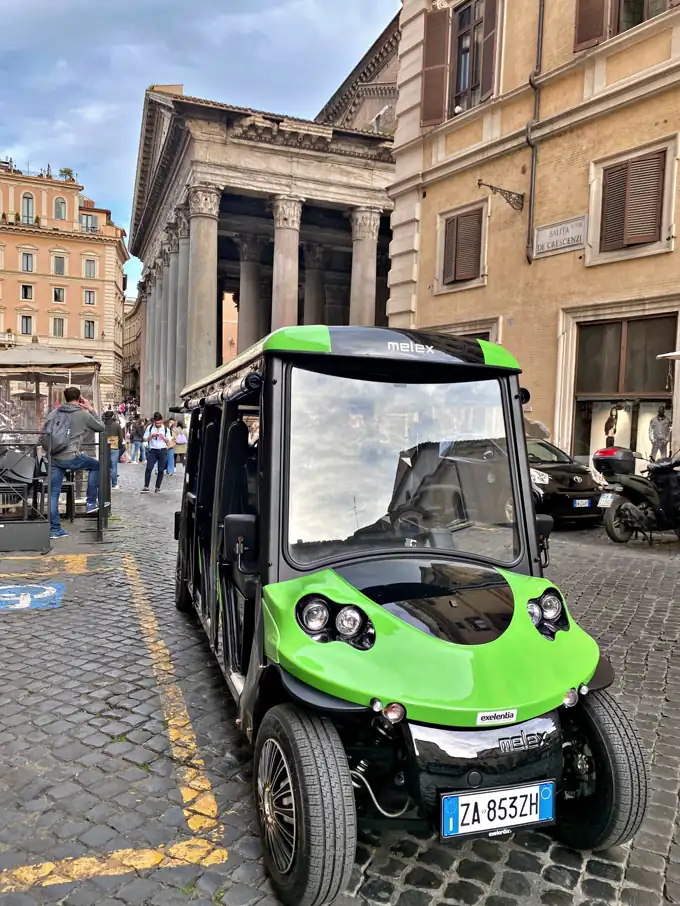
If your day in Rome is short, the thermometer is in the thirties, or the group includes anyone whose feet are already negotiating with you by lunchtime, a small electric cart is quietly the best-kept secret in the city. They're road-legal four-seater quadricicli — license plates, seat belts, professional drivers — and they are permitted inside the centro storico's Limited Traffic Zone, the 4.2 km² area where taxis crawl and the hop-on-hop-off bus simply isn't allowed.
A standard 2.5- to 3-hour highlights loop covers the same exterior set you'd otherwise spend a full day chasing on foot: the Colosseum, Circus Maximus, Piazza Venezia, the Pantheon, Piazza Navona, the Trevi Fountain, the Spanish Steps and Castel Sant'Angelo — with a stop at the Bocca della Verità on the way through. Group/shared tours start around $45–$70 per person; private tours run $120–$220. Cruise passengers, multi-generational families, couples on a night tour and anyone with a central hotel and limited mobility are the four bookings that make up the bulk of the category.
Rome: Golf Cart Tour with Artisanal Gelato Tasting
The most-reviewed golf cart tour on the Rome market — 1,858 verified reviews at 4.8★ for City Walkers Tours, with a working loop past the Colosseum, Circus Maximus, Piazza Venezia, the Pantheon and Piazza Navona, a real artisanal gelato stop, and the Bocca della Verità photo on the way back. From $45 per person, free cancellation up to 24 hours before — the lowest entry price of any guided golf cart tour in Rome.
Practical FAQ
The practical questions, answered as directly as possible. Same questions, same answers as the JSON-LD FAQPage markup that feeds Google's rich-result snippet and AI-assistant citations.
Is one day in Rome enough?
One day is not enough to know Rome, but it is enough to see its headline sights — the Colosseum, the Vatican Museums, the Pantheon and the Trevi Fountain — if you start before 9 a.m. and book skip-the-line entry to the Colosseum and Vatican in advance. Most travelers who do Rome in a day return later for longer; few regret the day they had.
Can you see the Vatican and the Colosseum in one day?
Yes, but only with pre-booked timed-entry tickets at both sites. The two are about 4 km apart — 15 to 25 minutes by taxi, 25 to 30 minutes by Metro Line B then Line A. The fastest combo tours move guests by private minivan between the two and finish with a guided walk through the centro storico in a single 7-hour day.
Should I do the Vatican or the Colosseum first?
Start with whichever has your earliest reserved time slot. If both are flexible, the pro-Vatican-first camp argues the museums get worse as the day progresses; the pro-Colosseum-first camp argues morning light is better at the Forum. The pragmatic answer for most one-day visitors: Vatican in the morning to beat the 10:30–13:00 peak, Colosseum after lunch when the Forum is still walkable.
Is a guided tour of Rome worth it for one day?
For a one-day visit, almost always yes. A licensed guide skips the 60–90 minute ticket queues at both the Colosseum and the Vatican, uses the connecting door from the Sistine Chapel to St Peter's that's only open to guided groups, and saves the 30–45 minutes of decision time most independent visitors spend per major choice. Most one-day combo tours run $175–$406 per person.
How far in advance should I book Vatican and Colosseum tickets?
Three to four weeks ahead in shoulder season, six-plus weeks in July, August, Easter and Christmas. Vatican slots release roughly 30 days in advance; Colosseum slots release on a similar window with limited daily quotas. The 8:30 a.m. Colosseum slot — the best entry of the day — can sell out within hours.
What's the dress code at the Vatican?
Shoulders and knees covered at the Vatican Museums, Sistine Chapel and St Peter's Basilica. No tank tops, no spaghetti straps, no shorts or miniskirts. Applies to men and women. Enforcement is year-round and unforgiving — visitors are turned away with no refund. A lightweight scarf or pashmina draped over bare shoulders is the universal workaround and is explicitly allowed.
How do you get from Civitavecchia cruise port to Rome?
Civitavecchia is about 80 km (50 miles) northwest of central Rome. The seasonal Civitavecchia Express train reaches Roma San Pietro in 35 minutes (€5–10). A regional train to Roma Termini runs 65–80 minutes. Private transfers run €160–€215 round trip for two and 60–75 minutes one way. Most cruise-day combo tours include port pickup and guarantee return to the ship before all-aboard.
What is the best month to visit Rome?
Late April to early June, and mid-September to late October. Mild temperatures (16–25°C / 61–77°F), long daylight and fewer queues than peak summer. Avoid mid-July to mid-August: heat regularly exceeds 32°C / 90°F and queues are at maximum. January and February are the budget sweet spot — hotel rates 30–40% lower and the Vatican is genuinely peaceful.
How much should I spend per day in Rome?
Self-guided couple: €120–€200 for entries, taxis, lunch, gelato and water. Group combo tour for two: €350–€500 all-in. Private guided day: €700–€1,200. Vatican entry is €20 standard, Colosseum is €16, the Pantheon is €5 since 2023. Lunch near major monuments runs €30+ per dish for routinely mediocre food — eat one street back.
Is Rome safe? What about pickpockets at the Trevi Fountain?
Rome is safe for walking but recent studies flag the Trevi Fountain and major Metro stations as Europe's worst pickpocket hotspots. Carry only what you need, use a cross-body bag, and keep your phone out of your back pocket. Tourist-touts selling fake skip-the-line tickets near the Colosseum and Vatican are common — buy only from licensed operators or official ticket counters.
Can you do Rome in a day with kids?
Yes — pick the Colosseum (gladiator stories), the Pantheon (the oculus rain trick), and an evening centro storico walk over the Vatican (3 hours of art is rough for under-12s). Golf-cart tours work well for families: they cover ground efficiently and skip the cobblestone fatigue. Most operators offer reduced child pricing on combo tours; bring ID matching every ticket name.
What should I skip in Rome if I only have one day?
Skip the Spanish Steps as a planned destination (see them in passing). Skip restaurants within sight of any monument. Skip gladiator photo-ops outside the Colosseum. Skip the Trevi Fountain at midday in summer — go at dawn or after 11 p.m. instead. Skip hop-on-hop-off buses; they're slow in Roman traffic. The Pantheon, by contrast, is universally cited as the unexpected one-day highlight.
What to skip
A guide earns trust by telling visitors what not to do as much as what to do. These are the recurring regrets in Tripadvisor and Reddit threads about one-day Rome, and the recurring "I wish we hadn't" notes in the editorial corpus.
- The Spanish Steps as a destination. See them in passing on the way somewhere else. One representative Reddit comment: "I was floored by how underwhelmed I was." Sitting on them has been illegal since 2019 anyway.
- Restaurants within sight of a major monument. The €30-for-microwaved-spaghetti experience near Piazza Navona is, sadly, a recurring story. Walk one street back, look for a menu without English translations, and prices halve.
- Gladiator photo-ops outside the Colosseum. Overpriced, aggressive, "synthetic armor."
- The Trevi Fountain at midday in summer. The fountain itself is non-negotiable, but the noon-July experience is widely described as miserable. Go at dawn or after 23:00.
- The Vatican interior in peak July/August. One Spectator writer is blunt: "The Vatican Museums are, like the Louvre's Mona Lisa, so crowded as to be borderline unvisitable."
- Hop-on-hop-off buses. Slow in Roman traffic. Useful as a city orientation if you have three+ days, useless on a one-day plan.
- The Roma Pass on a one-day visit. Single-day visitors rarely break even on the 24-hour version. Buy individual tickets.
When to come, what to wear, how to behave
1. The best months
Late April to early June and mid-September to late October are the unanimous expert pick (Rick Steves, Walks of Italy, GetYourGuide, Carpe Diem Tours, Royal Caribbean). Mild temperatures, long daylight, fewer queues. Avoid mid-July to mid-August: heat regularly exceeds 32°C / 90°F and queues are at maximum. January and February are the budget sweet spot — hotel rates 30–40% lower and the Vatican is genuinely peaceful.
2. The best time of day
Colosseum: 08:30 opening or after 15:00. Vatican Museums: 08:00 opening or the last 2-hour slot. Pantheon: 09:00–11:00 or after 18:00 for the oculus daylight effect. Trevi Fountain: before 08:00 or after 23:00 for a photo without 100 strangers in frame.
3. Getting around Rome in one day
Walking is the default — centro storico distances are small (Trevi to Pantheon is a 7-minute walk). The big jump is Colosseum to Vatican at 4 km / 2.5 miles. Options: taxi (€12–€18, 15–25 min), Metro Line B to Termini then Line A to Ottaviano (25–30 min total), or a tour-included private minivan. Single Metro ticket is €1.50.
4. Dress code (the rule that gets people turned away)
Shoulders and knees covered at the Vatican Museums, Sistine Chapel and St Peter's Basilica. No tank tops, no spaghetti straps, no shorts or miniskirts. Applies to men and women. Sandals are fine; beach flip-flops are not. No hats inside St Peter's (allowed in the Museums). Enforcement is consistent, year-round, and unforgiving — visitors are turned away with no refund. A lightweight scarf or pashmina draped over bare shoulders is the universal workaround and is explicitly allowed.
5. What to bring
- Comfortable closed-toe walking shoes (sampietrini cobblestones)
- Lightweight scarf or pashmina (for Vatican shoulder coverage)
- Refillable water bottle (Rome's nasoni drinking fountains are excellent and free)
- Government photo ID matching the name on every ticket
- Small daypack within Vatican size limit (40×35×15 cm)
- €10–€20 cash for tips and small purchases
6. Physical accessibility
The Vatican Museums are step-free via the Viale Vaticano entrance with elevators throughout (free wheelchairs available). St Peter's Basilica is accessible at the main entrance; the dome climb is not. The Colosseum's standard tiers are reachable by elevator; the Arena Floor and Underground are not. The Roman Forum is largely not wheelchair-accessible due to uneven ground. Golf-cart tours and adapted private tours are the practical solution for mobility-limited visitors.
7. Important tips most first-timers miss
- The Vatican is closed Sundays except the last Sunday of the month (09:00–14:00, free entry, very crowded).
- The Colosseum is free on the first Sunday of each month — very crowded; book a free timed slot in advance.
- Wednesday mornings the Pope holds the Papal Audience in St Peter's Square; the Basilica interior closes to general visitors.
- Italian kitchens often close 14:30–19:00. Tour groups solve this by building lunch into the schedule — independent visitors should eat by 14:00 or wait until 19:00.
- The Sistine Chapel is a working chapel: silence and no-photos are enforced. The disorientation from the loud galleries into that silence is, by widespread account, the closest thing to a religious experience most travelers have on a city break — regardless of belief.
You won't see Rome in a day. You'll see enough of Rome in a day to know you'll come back.— Rome in a Day editorial